
PODCAST
How Flagright uses AI to keep your money safe | Baran Ozkan, Flagright





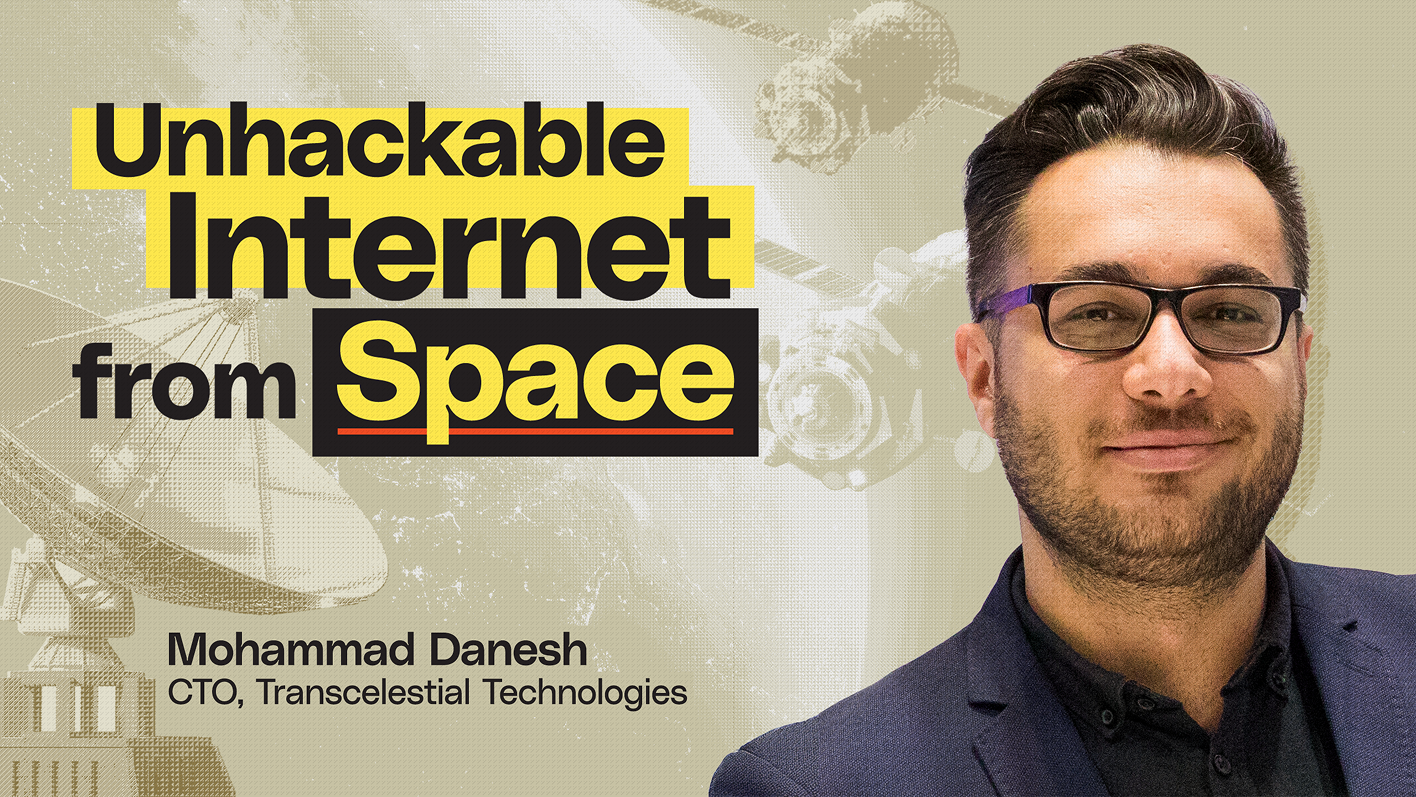
It was at a space conference at NUS that Dr. Mohammad Danesh had his catalyst moment. A speaker was detailing the next generation of nanosatellites and their biggest challenge: they could collect vast amounts of data but couldn't send it back to Earth. For Dr. Danesh and his co-founder, the solution was a "no-brainer" — lasers.
The bottleneck wasn't unique to space. On the ground, 99% of the world's data travels through fibre optic cables, but these are difficult and expensive to deploy, leaving a billion people without quality connectivity. Traditional wireless is flexible but spectrum-congested. Transcelestial was born from this insight: take the laser from inside a fibre optic cable and send it wirelessly, creating a new internet backbone for the planet and beyond.
A self-described nerd, Dr. Danesh’s path was forged by a fascination with electromagnetic waves, leading him to a PhD in Nanophotonics. While the science was thrilling, he grew frustrated with the academic cycle, "Why are we not trying to now do something useful with this? Why just publish and leave?".
In 2016, he co-founded Transcelestial to turn this vision into reality — a pivot from pure research to world-changing hardware that earned him a place on the Forbes 30 Under 30 in 2019. The company's core solution is a form of "wireless fibre," using lasers to transmit data at high speeds without physical cables. Their terrestrial product, the Centauri, can deliver up to 40Gbps of connectivity over distances of up to three kilometres, being the world's first bandwidth-on-demand wireless laser communications platform.
👏 Dive deeper into this conversation and many others with innovative founders on the Unsensible Podcast:
The journey, however, has been fraught with challenges far exceeding the initial scientific discovery. Dr. Danesh candidly refers to the process of scaling production as "manufacturing hell," a phase he admits he grossly underestimated. Building a single laser product is hard, but "to repeatedly build your original product... is at least 10 times more difficult," he explains. The company spent years and millions of dollars to create a facility where technicians with "no education in precision optics" could assemble the highly complex devices.
This experience shaped his philosophy on leadership, which is rooted in radical trust and delegation. He believes founders must resist the urge to be control freaks and empower their teams by handing over the most significant challenges. "Trust your team and give them the good, big, interesting things to do as well," Dr. Danesh advises. "Otherwise, you're never gonna have time to do it yourself."
Looking forward, Dr. Danesh offers an uncompromisingly visionary prediction for the next decade, seeing space as the first and easiest frontier for laser communications to conquer. "I think within five years, we're going to have constellations running, major big constellations running out of space that use lasers end to end," he states. "That infrastructure becomes the new space communication infrastructure," a secure, quantum-encrypted backbone for the global economy.